For years, rooftop solar owners have been sold a simple promise: generate excess electricity, feed it back into the grid, and get credited for it later. In theory, everybody wins. The homeowner saves money, the grid gets clean power, and the country reduces strain on generation infrastructure.
Then came the backlash.
Utilities, regulators, and critics started using a loaded phrase: “free riders.” The accusation is that solar households still rely on the grid’s wires, transformers, and maintenance — but avoid paying their fair share because their monthly bills are lower.
For many homeowners, that feels absurd.
After all, if you spent hundreds of thousands of rand installing panels, why should you be punished for reducing demand and contributing power during the day? Why should a household trying to be more energy efficient be treated like a problem?
The frustration is understandable. But there is also an uncomfortable reality underneath the debate:
The traditional electrical grid was never designed for millions of mini power stations feeding energy back into it.
And that is exactly why the smartest homeowners have stopped obsessing over feed-in tariffs, net metering policies, and “fair” export credits.
Instead, they are building systems designed to make those debates irrelevant.
The “Free Rider” Myth: Why Both Sides Are (Partially) Right
The controversy around the solar free rider problem exists because both sides are arguing from a position that contains some truth.
From the homeowner’s perspective, rooftop solar absolutely provides value to the grid:
- Reduced daytime demand
- Cleaner electricity generation
- Less strain during peak production hours
- Lower dependence on coal and diesel generation
- Greater energy resilience during shortages
A homeowner with a properly installed solar system is not “doing nothing.” They are investing private capital into national energy capacity.
But utilities are also dealing with a real technical and financial issue.
The grid has enormous fixed costs:
- Transmission lines
- Substations
- Maintenance crews
- Metering infrastructure
- Voltage balancing
- Frequency stabilization
- Emergency response systems
Those costs do not disappear just because a household buys fewer kilowatt-hours.
And here is the critical point most people miss:
The old grid model was built for one-way power flow — from centralized power stations to consumers.
Modern rooftop solar creates two-way flow, which is far more complicated and expensive to manage.
That means utilities are trying to recover fixed infrastructure costs from a shrinking pool of traditional electricity sales.
This is why you increasingly see:
- Grid maintenance fees
- Reduced feed-in tariff rates
- Fixed monthly connection charges
- Lower export compensation
- Restrictions on net metering
This is not primarily about morality. It is about economics and infrastructure design.
The problem is that homeowners keep assuming the system will eventually become “fair.”
History suggests otherwise.
The Rigged Game: Why You’ll Never Win the Grid-Credit War
Across the world, feed-in tariff rates are trending downward.
In many regions, exported solar energy is now worth only a fraction of retail electricity prices.
That creates a brutal imbalance.
You may buy electricity from the grid at:
- R3.00–R4.50 per kWh during peak periods
…but only receive:
- R0.60–R1.20 per kWh when exporting excess solar energy.
In other words, utilities buy your power wholesale and sell it back retail.
And politically, homeowners are at a disadvantage.
Utilities:
- Have lobbying power
- Influence regulators
- Control infrastructure
- Shape tariff structures
- Frame public narratives
The average homeowner has:
- One roof
- One meter
- One complaint email
Waiting for the “perfect” net metering policy is increasingly a losing strategy because utilities are incentivized to protect revenue stability, not maximize your solar ROI.
That is why homeowners obsessed with export credits are fighting the wrong battle.
Even if you temporarily win better rates, the long-term trend is obvious:
- More fixed charges
- Lower export compensation
- Greater tariff complexity
- Time-of-use pricing
- Reduced profitability for grid export
The house almost always rewrites the rules in its favor.
The question is not whether that is fair.
The question is whether you want your financial future tied to those rules.
The Reframe: From “Grid-Tied” to “Grid-Independent”
This is the mental shift that changes everything.
The smartest solar homeowners are no longer trying to become miniature utility companies.
They are trying to become their own power providers.
That means the goal changes from:
- “How much can I sell back?”
to:
- “How little do I need from the grid?”
That single shift transforms the economics of solar.
A traditional grid-tied system treats the grid like a battery.
A modern hybrid system treats your battery like the battery.
That distinction matters enormously because stored solar energy is almost always more valuable than exported solar energy.
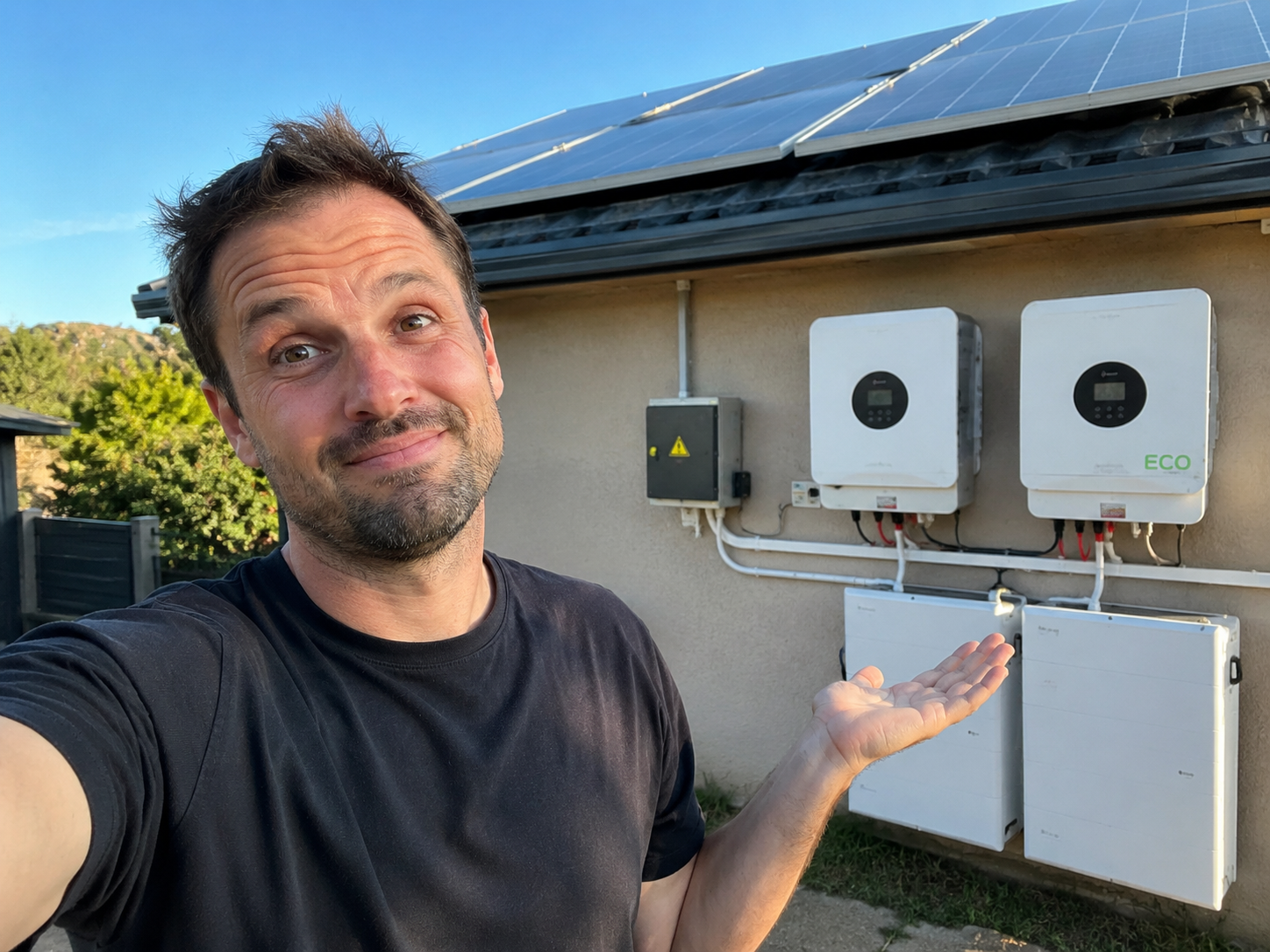
This is where the Hybrid Inverter + Lithium Battery combination becomes the real exit strategy.
Instead of sending surplus power to the grid for low-value credits, a hybrid system stores excess daytime production and uses it later:
- During evening peak tariffs
- During loadshedding
- During outages
- During high-demand appliance usage
The result is dramatically higher self-consumption and far less dependence on utility pricing games.
Stop selling your power for pennies. See how much you save by storing it instead.
For many households, this is the moment the economics finally make sense.
Self-Consumption: The Only Metric That Matters
Most homeowners focus on total solar production.
That is the wrong metric.
The metric that actually determines long-term solar ROI is:
Solar Self-Consumption Ratio
That means:
How much of your own solar energy do you use yourself?
Because every unit of electricity you consume directly is worth the full retail electricity rate you avoided paying.
If Eskom or your municipality charges:
- R4.00 per kWh
…and your feed-in tariff only pays:
- R1.00 per kWh
…then self-consuming your power is effectively worth 4x more than exporting it.
That changes system design priorities completely.
The best systems are no longer optimized for maximum export.
They are optimized for:
- Peak shaving
- Battery storage
- Evening usage
- Load shifting
- Backup resilience
- High self-consumption
This is why lithium battery systems have become central to serious energy independence strategies.
And unlike older lead-acid systems, modern lithium setups:
- Last longer
- Charge faster
- Require less maintenance
- Deliver deeper discharge cycles
- Expand modularly over time
The result is not just backup power.
It is partial freedom from utility economics.
Choosing Your Exit Strategy: Which System Fits Your Home?
Not every household needs full off-grid capability.
The right hybrid solar system depends on:
- Monthly consumption
- Budget
- Outage frequency
- Independence goals
- Future expansion plans
The key is matching the system to the lifestyle.
| System | Best For | Independence Level | Ideal Outcome |
|---|---|---|---|
| Ecco 3.5KVA Trolley | Apartments / Essentials Backup | Low–Moderate | Keep critical devices running during outages |
| Ecco 5.5KVA + 5.12kWh | Family homes | Moderate–High | Slash grid dependence and maximize self-consumption |
| Deye 8KW + Dual Dyness Batteries | Large homes / Power users | High–Very High | Near-total energy independence |
Tier 1: The Budget-Conscious Backup (Loadshedding Focus)
For many South Africans, the first step toward energy independence is simply surviving loadshedding comfortably.
That is where entry-level hybrid and trolley systems make sense.
Ecco 2000W Hybrid Combo
Ideal for:
- Small households
- Apartments
- Essential appliances
- Internet, TV, lighting, laptops
Advantages:
- Lower upfront cost
- Hybrid functionality
- Expandable pathway into larger systems
- Reduced generator dependence
Tradeoff:
- Limited heavy appliance capability
- Not designed for whole-home independence
Ecco 3.5KVA Trolley
This category has exploded in popularity because it combines portability with practical backup performance.
Strong fit for:
- Renters
- Budget-conscious homeowners
- Remote workers
- Moderate outage protection
Decision Reinforcers:
- Avoids productivity losses during outages
- Future-proof entry into battery storage
- Lower maintenance than fuel generators
For many households, this is the gateway into long-term hybrid energy planning.
Tier 2: The Self-Consumption Sweet Spot (Family Homes)
This is where the economics become particularly compelling.
A properly sized hybrid inverter and lithium battery setup can dramatically reduce monthly electricity purchases while providing excellent backup resilience.
Ecco 5.5KVA + 5.12kWh Wall Mount
This is arguably the sweet spot for many suburban family homes.
Strong fit for:
- Families with daytime consumption
- Homes running fridges, TVs, internet, lighting, and moderate appliance loads
- Households wanting lower bills without full off-grid costs
Why it works:
- High self-consumption potential
- Excellent balance between cost and savings
- Handles evening peak usage effectively
- Significantly reduces exposure to tariff increases
Decision Reinforcers:
- Can pay for itself faster by offsetting expensive retail electricity
- Modular battery expansion possible later
- Hybrid architecture adapts well to future solar additions
Luxpower 5000W Trolley
This category appeals to homeowners wanting flexibility without committing immediately to a fixed large-scale installation.
Strong fit for:
- Growing households
- Hybrid backup + savings strategy
- Users transitioning gradually toward independence
Tradeoff:
- Less elegant than fully integrated wall systems
- Expansion planning becomes important
But financially, this tier is often where homeowners stop caring about feed-in tariff politics entirely.
Because the savings come primarily from avoiding retail purchases — not exporting energy.
Tier 3: The Total Independence Powerhouse (Off-Grid Ready)
For some homeowners, the goal is not lower bills.
The goal is sovereignty.
These systems are designed for households wanting:
- Minimal utility dependence
- Large battery reserves
- Whole-home capability
- High solar self-consumption
- Long-term resilience
Deye 8KW + Dual Dyness 5.12kWh Batteries
This is serious hybrid infrastructure.
Strong fit for:
- Large homes
- High-consumption households
- Homes with pools, pumps, offices, air conditioning
- Long-term energy independence planning
Why premium hybrid systems matter:
- Advanced load management
- Excellent scalability
- Sophisticated battery integration
- Better handling of peak appliance loads
- Strong compatibility with future expansion
Decision Reinforcers:
- Future-proof architecture
- Massive reduction in utility exposure
- Strong long-term ROI under rising electricity prices
Ecco 6.2KVA + 6x 460W Panels
A compelling mid-to-upper-tier option for homeowners wanting strong solar production combined with meaningful backup capability.
Strong fit for:
- Medium-to-large homes
- Homeowners targeting aggressive self-consumption
- Families planning gradual off-grid transition
Tradeoff:
- Higher upfront investment
- Requires proper system sizing and installation planning
But at this level, the homeowner is no longer merely reacting to utility policies.
They are strategically reducing dependency on them.
Conclusion: Stop Arguing, Start Storing
The “free rider” debate only matters if your financial survival depends on utility approval.
That is the real insight.
If your strategy depends on:
- favorable export rates,
- generous net metering,
- or permanently fair utility policies,
…then your savings remain vulnerable to regulatory changes you cannot control.
But homeowners prioritizing self-consumption and battery storage operate under a completely different model.
They are not trying to profit from the grid.
They are trying to need it less.
That is why hybrid solar systems have become the defining technology of modern residential energy strategy.
Not because utilities are evil.
Not because solar owners are saints.
But because the old centralized electricity model is increasingly unstable, politically contested, and economically misaligned with homeowner interests.
The households seeing the strongest long-term returns are the ones that stopped fighting for better credits and started maximizing independence instead.
Quick Picks
The Budgeter
- Best Fit: Ecco 3.5KVA Trolley
- Goal: Affordable loadshedding resilience
The Family Man
- Best Fit: Ecco 5.5KVA + 5.12kWh
- Goal: Lower bills and high self-consumption
The Prepper
- Best Fit: Deye 8KW + Dual Dyness Batteries
- Goal: Near-total utility independence
The future of residential solar is not about selling electricity back to the grid.
It is about building a home that can increasingly power itself.
Don’t wait for the next tariff hike.
Build your own energy fortress today.

Newsletter Signup
Subscribe to our monthly newsletter below and never miss the latest product or an exclusive offer or the latest developments in Off Grid Solar in SA.